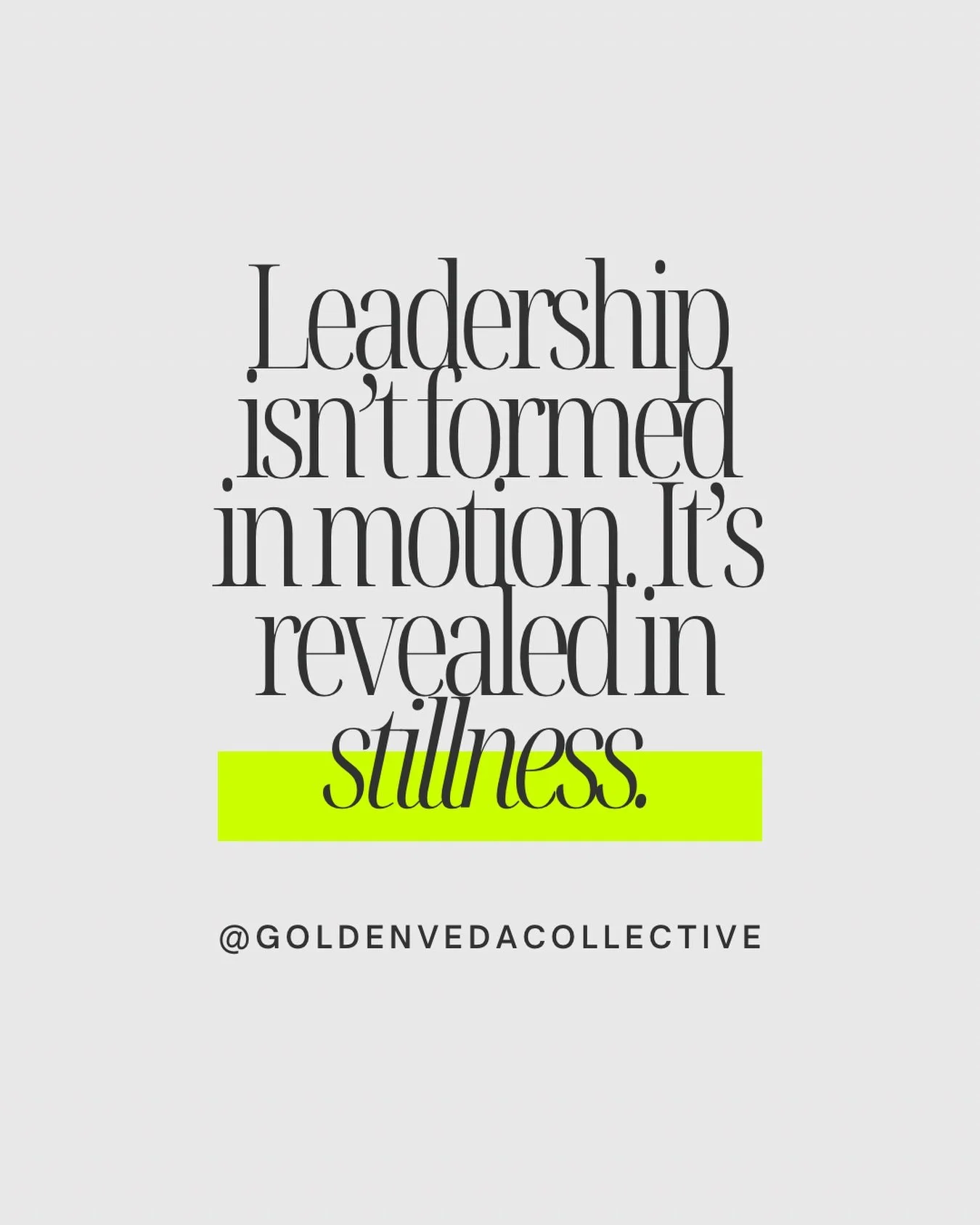

Leadership Isn’t Formed in Motion — It’s Revealed in Stillness
Leadership is often forged in motion — speed, effort, constant decision-making. But some of the most important leadership work happens when movement stops. This essay explores why stillness, uncertainty, and unchosen pauses are not signs of stagnation, but thresholds where deeper clarity, purpose, and coherence are revealed.

Leadership is often described as something forged through movement — momentum, discipline, constant decision-making. We praise speed, resilience, and the ability to keep going. But in my experience, leadership is not formed in motion. It is revealed in stillness, when the noise falls away and there is nothing left to outrun.
Stillness is uncomfortable precisely because it removes the structures we use to define ourselves. Effort gives us roles. Urgency gives us identity. Busyness offers the illusion of progress. When movement stops, what remains is not weakness, but truth — the parts of our leadership that no longer require performance to exist.
I came to understand this not through theory, but through absence. When a fourteen-year body of work came to an end, the momentum I had relied on disappeared with it. What followed was an unchosen quiet — a stretch of time that demanded listening instead of doing, and revealed aspects of leadership that could only emerge when effort was no longer available.
What stillness exposes most sharply is not a lack of direction, but a collapse of purpose as we once understood it. When motion ends, the question that surfaces isn’t What should I do next? but Who am I now, without the roles that once defined me? This is where many people mistake stillness for stagnation, because purpose no longer feels obvious or externally validated.
We are taught to believe that purpose is something we can articulate, refine, and follow — a clearly defined “why” that guides every decision forward. Entire libraries are dedicated to helping us uncover it. And yet, when stillness arrives — through endings, loss, or unchosen pauses — those frameworks often fail us. They assume a stable identity and a clear starting point. They do not account for the disorientation that comes when the old purpose dissolves before a new one has taken shape.
In these moments, feeling lost is not a sign that stillness isn’t working. It is the work. Purpose does not announce itself in the quiet the way it does in motion. It does not arrive as a mission statement or a declaration. It begins instead as a subtle reorientation — a pulling away from what no longer fits, long before clarity about what comes next is available.
Stillness asks us to stay present without answers — and for the conscious leader, this may be the most uncomfortable invitation of all. Leadership often rewards certainty: decisiveness, reassurance, the ability to guide others forward with confidence. But in moments of true stillness, certainty is not available. What is required instead is the capacity to remain grounded while the answer has not yet arrived.
For many leaders, the reflex in these moments is to reach for resolution — to fill the silence with strategy, action, or explanation. Yet when we resist the urge to prematurely decide, something unexpected happens. The absence of an immediate answer creates space. New possibilities emerge. Perspectives that were invisible under pressure begin to surface. Not having the answer does not weaken leadership; it deepens it. It shifts authority from control to presence.
In Ayurveda, there is a term for the kind of misstep that occurs when intellect moves faster than wisdom. Pragya aparādha describes the tendency to act before clarity has fully integrated — to make decisions not because they are right, but because uncertainty feels intolerable. In leadership, this often looks like movement without alignment: action taken to relieve discomfort rather than honor discernment.
Stillness, then, is not the absence of leadership — it is a refinement of it. When we allow ourselves to remain in the quiet without rushing toward purpose or certainty, we begin to hear what effort has been drowning out. Purpose does not arrive fully formed in these moments. It emerges slowly, as discernment. As subtraction. As a deepening awareness of what no longer belongs.
This is where many people become afraid they are stuck, when in fact they are being asked to listen differently. Stillness can feel barren because it removes the familiar markers of progress. But it is often in these empty spaces that leadership reorients itself — not around identity or output, but around integrity. Around coherence. Around the quiet confidence of not needing to know yet.
I have learned to trust these pauses — not because they are comfortable, but because they are honest. Again and again, stillness has revealed what motion never could: the difference between action that sustains us and action that simply keeps us busy. The difference between purpose that is inherited and purpose that is lived.
Some decisions do not require more effort.
They require space.
And some of the most important leadership we will ever practice is the willingness to stay present — without answers — until the right ones are ready to emerge.